![cropped-Dabba-Trading a[1]](https://dabbatrading.com/wp-content/uploads/2025/08/cropped-Dabba-Trading-a1-300x48.png)
Introduction
Commodity markets attract traders looking to capitalize on price movements in assets such as gold, silver, crude oil, natural gas, and agricultural products. Alongside regulated exchanges and licensed brokerage firms, an unofficial trading ecosystem has existed for decades—commonly referred to as commodity dabba trading.
Despite increased market transparency and regulatory oversight, many traders still encounter terms such as “dabba broker” or “dabba trading brokerage.” Some are curious about how these arrangements work, while others may be attracted by promises of lower margins, higher leverage, or simplified account opening procedures.
Understanding the mechanics, risks, and legal implications of commodity dabba trading is essential before participating in any form of commodity speculation. This guide explains the concept in detail, compares it with regulated trading, and highlights why investor protection remains one of the most important considerations in financial markets.
What Is Commodity Dabba Trading?
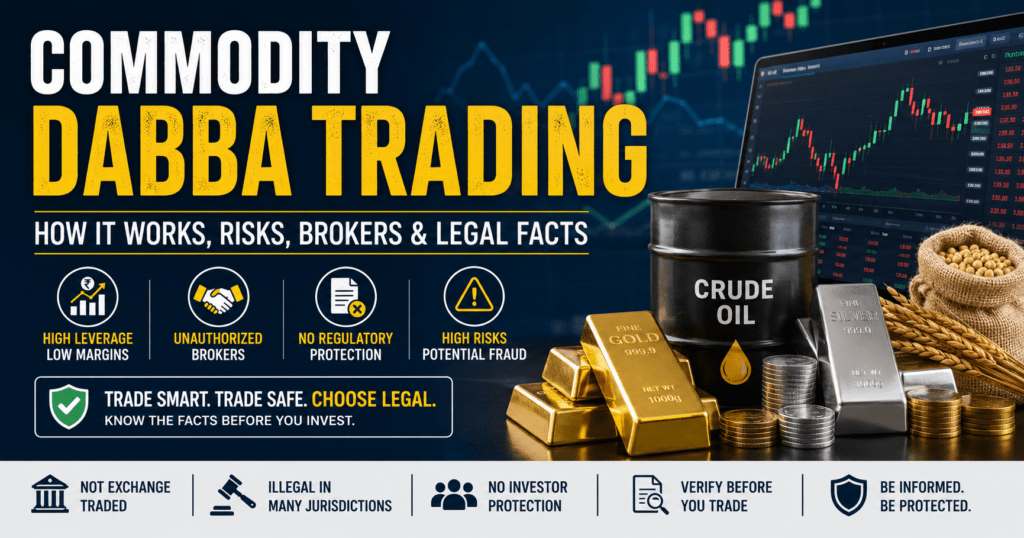
Commodity dabba trading is an unauthorized form of speculative trading where transactions are conducted outside recognized commodity exchanges.
In a regulated market, every trade is routed through an exchange, recorded electronically, monitored by regulators, and settled through established systems. In dabba trading, however, the transaction typically remains within a private network operated by an intermediary.
Instead of executing a genuine commodity futures contract, the operator simply records the trader’s position and settles profits or losses based on market price movements.
The result is a system that mirrors exchange prices without actually participating in the official market.
How Commodity Dabba Trading Works
To understand the concept, consider a trader who expects crude oil prices to rise.
In a Regulated Environment
The trader:
- Opens an account with a registered brokerage firm.
- Completes compliance requirements.
- Deposits margin funds.
- Places an order through an approved platform.
- Has the trade recorded on an exchange.
Every transaction becomes part of the official market infrastructure.
In an Unofficial Arrangement
The trader:
- Communicates directly with an operator.
- Requests a position in crude oil.
- Receives confirmation from the operator.
- Tracks profits and losses based on market movements.
- Settles gains or losses privately.
No official exchange execution occurs, even though the trade may appear to resemble a genuine commodity transaction.
The Role of a Dabba Broker
A dabba broker acts as the intermediary between traders and the unofficial trading network.
Their responsibilities often include:
- Recording client positions.
- Managing leverage arrangements.
- Tracking market prices.
- Calculating profit and loss.
- Handling settlements.
Unlike licensed intermediaries, these operators do not generally provide the safeguards associated with regulated financial markets.
This distinction becomes particularly important when disputes arise over trade execution, account balances, or withdrawals.
Why Some Traders Are Attracted to Dabba Trading
The continued existence of unofficial trading networks raises an obvious question: why do some traders choose them despite the risks?
Several factors contribute to their appeal.
Lower Entry Requirements
Some participants are drawn to the perception that less capital is needed to begin trading.
Simplified Procedures
Account opening processes may appear faster and involve fewer formal requirements.
Higher Leverage
Certain operators promote leverage levels that exceed those typically available through regulated channels.
Informal Operations
Some traders mistakenly believe that avoiding official systems offers flexibility or convenience.
While these characteristics may seem attractive initially, they often come at the cost of transparency, investor protection, and legal certainty.
Understanding Dabba Trading Brokerage
The term “dabba trading brokerage” generally refers to the fees, commissions, or spreads charged by operators facilitating unofficial trades.
Unlike regulated brokerage structures that disclose charges through standardized statements, unofficial arrangements may use varying fee models, including:
- Fixed transaction charges
- Spread-based earnings
- Overnight position fees
- Informal leverage charges
Because these systems operate outside standard oversight mechanisms, fee transparency can vary significantly.
The Biggest Risks Traders Often Overlook
The discussion around dabba trading frequently focuses on leverage and accessibility. However, the most important considerations involve risk.
Lack of Regulatory Protection
Regulated markets are designed to protect participants through oversight, reporting requirements, and dispute resolution mechanisms.
Unofficial trading arrangements generally do not offer comparable safeguards.
Counterparty Risk
The trader relies entirely on the operator’s ability and willingness to honor settlements.
If disagreements occur, proving the existence and terms of a transaction may be difficult.
Fund Security Concerns
Investor funds in regulated markets are subject to specific compliance standards.
In unauthorized systems, there may be limited visibility regarding how client money is handled.
Pricing and Execution Disputes
Because transactions are not executed on an exchange, disagreements may arise regarding:
- Entry prices
- Exit prices
- Position sizes
- Profit calculations
Limited Legal Recourse
Recovering losses through legal channels can be significantly more challenging when transactions occur outside recognized frameworks.
Commodity Dabba Trading vs Regulated Commodity Trading
Understanding the difference between these two approaches helps traders make informed decisions.
| Factor | Unofficial Dabba Trading | Regulated Commodity Trading |
|---|---|---|
| Exchange Execution | No | Yes |
| Regulatory Oversight | Limited or None | Extensive |
| Investor Protection | Limited | Structured |
| Official Trade Records | No | Yes |
| Transparency | Lower | Higher |
| Compliance Standards | Uncertain | Defined |
| Dispute Resolution | Difficult | Established |
| Settlement Framework | Informal | Regulated |
The key distinction is not merely where a trade occurs, but whether the participant benefits from recognized market protections.
A Practical Example
Imagine two traders with identical market views on gold futures.
Trader A uses a regulated brokerage account and executes an exchange-listed contract.
Trader B enters a similar position through an unofficial operator.
If gold prices rise, both traders may appear to profit.
However, complications arise when unexpected situations occur:
- Withdrawal requests
- Settlement disputes
- Margin disagreements
- Record verification issues
Trader A can generally rely on documented trade records and established procedures. Trader B may depend entirely on the operator’s internal records.
This difference becomes critical when conflicts emerge.
Common Warning Signs
Investors should carefully evaluate any trading arrangement before committing funds.
Potential red flags include:
- Promises of guaranteed profits.
- Excessively high leverage offers.
- Cash-only settlement requirements.
- Absence of official trade confirmations.
- Lack of transparent documentation.
- Pressure to avoid regulated channels.
- Unclear fee structures.
Responsible market participants should treat such indicators with caution.
The Importance of Investor Protection
One of the most overlooked aspects of trading is not profitability but protection.
Market volatility is inevitable. Losses are part of trading. The real question is whether participants operate within a framework designed to handle disputes, maintain records, and safeguard funds.
Investor protection mechanisms exist because financial markets involve significant risk. Transparency, compliance, and oversight help create trust between market participants.
When these safeguards are absent, risk increases substantially.
How Commodity Markets Have Evolved
Modern commodity trading has changed dramatically over the past decade.
Today’s traders have access to:
- Advanced charting platforms
- Real-time market data
- Mobile trading applications
- Algorithmic trading tools
- Risk management systems
- Educational resources
As technology continues to improve market accessibility, many of the historical reasons traders cited for using informal arrangements have become less compelling.
Best Practices for Commodity Traders
Regardless of experience level, traders should consider several foundational principles:
Verify Before You Trade
Always confirm the credentials and legitimacy of any intermediary.
Understand the Product
Commodity futures and derivatives involve substantial risk. Education should precede participation.
Maintain Documentation
Keep records of transactions, statements, and communications.
Prioritize Risk Management
Position sizing, stop-loss planning, and disciplined capital allocation remain essential.
Focus on Transparency
A transparent trading environment helps reduce uncertainty and supports better decision-making.
Frequently Asked Questions
What does commodity dabba trading mean?
It generally refers to commodity-related speculative activity conducted outside recognized exchange systems, where positions are recorded and settled privately.
Why do some traders use dabba trading networks?
Participants may be attracted by perceived flexibility, lower capital requirements, or higher leverage opportunities.
What is a dabba broker?
A dabba broker is an intermediary who facilitates unofficial trading arrangements rather than routing orders through a recognized exchange.
How is it different from exchange trading?
Exchange trading involves official execution, regulatory oversight, documented records, and investor protection mechanisms. Unofficial arrangements typically do not provide the same safeguards.
What are the primary risks?
Key concerns include fund security, settlement disputes, lack of transparency, counterparty risk, and limited legal recourse.
Why is transparency important in commodity trading?
Transparency helps ensure accurate pricing, proper recordkeeping, accountability, and investor confidence.
Can leverage increase trading risk?
Yes. While leverage can amplify gains, it can also magnify losses and increase exposure to market volatility.
What should traders evaluate before opening an account?
They should assess credibility, transparency, documentation standards, fee structures, risk controls, and compliance practices.
Conclusion
Commodity dabba trading remains a widely discussed topic because it sits at the intersection of market speculation, leverage, and informal trading practices. While some participants may view such arrangements as convenient, the absence of transparency, formal oversight, and investor safeguards creates significant concerns.
For anyone interested in commodity markets, understanding how unofficial trading structures differ from regulated systems is essential. The long-term success of a trader depends not only on market analysis but also on the quality of the environment in which trades are executed.
In financial markets, protection, transparency, and accountability are often just as important as profit potential. Traders who understand this principle are generally better positioned to make informed decisions and manage risk effectively.